
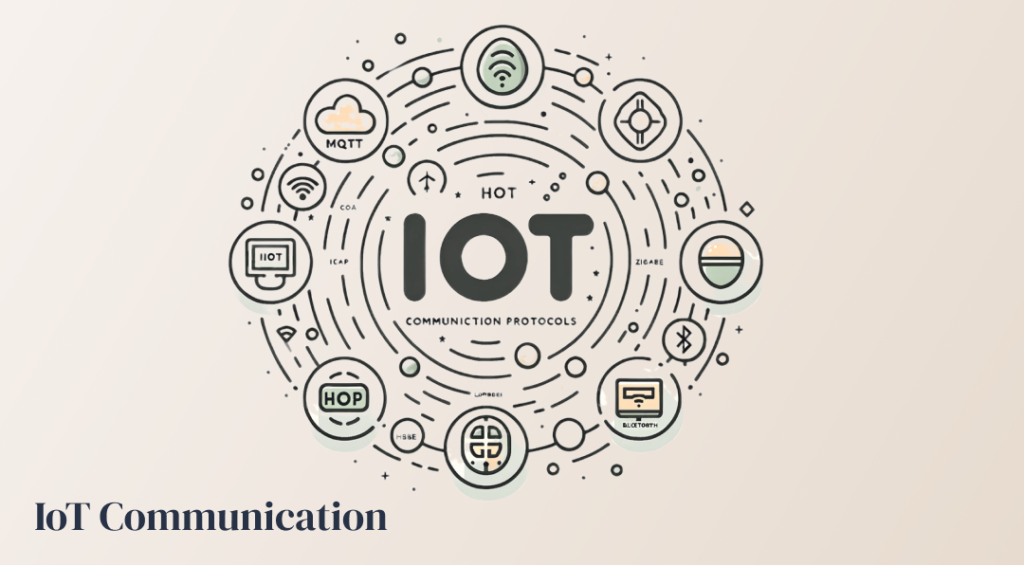
The IoT communication protocols by Axons Lab are ushering in a transformative era in our interaction with the world around us. It encompasses an extensive array of potential applications, ranging from smart homes to industrial automation. Central to this technological revolution are communication protocols that enable seamless connections between appliances and the broader internet. Let’s take a deeper dive into some of the most commonly employed communication protocols in the IoT landscape.
- MQTT (Message Queuing Telemetry Transport)
Advantages:
Efficiency: Requires minimal bandwidth, making it suitable for resource-constrained devices.
Versatility: Supports both one-to-many and many-to-one communication models.
Quality Assurance: Offers various levels of message delivery guarantees.
Reliability: Can notify other devices about an unplanned disconnection.
Disadvantages:
Security Considerations: Native MQTT lacks built-in encryption, necessitating additional security measures.
Broker Dependency: Requires a central broker, which may pose a single point of failure.
MQTT is a favored choice among IoT developers, primarily due to its lightweight nature. Tailored for appliances with limited resources and networks that may not always be dependable, MQTT operates on a publish/subscribe model. This model allows the machine to “publish” data to a central broker, enabling another machine to “subscribe” to this data, ensuring efficient and timely data exchange.
2. CoAP (Constrained Application Protocol)
Advantages:
Familiarity: Mimics HTTP methods, making it accessible for developers.
Low Overhead: Designed with minimal overhead for resource-constrained devices.
Automatic Discovery: Devices can discover services automatically.
Disadvantages:
UDP-based: Built on UDP, which doesn’t guarantee delivery by default (though it includes optional mechanisms for reliability).
Lower Adoption: Not as widely embraced as some other protocols.
CoAP is another protocol thoughtfully crafted for the IoT environment. It shares many characteristics with HTTP but is optimized for resource-constrained devices. Through its request/response interaction model, CoAP enables seamless communication among devices. Its built-in service discovery is particularly valuable for dynamic IoT networks where devices may frequently join or leave.
3. HTTP (Hypertext Transfer Protocol)
Advantages:
Pervasiveness: Universally recognized and used, with an abundance of resources and tools available.
Dependability: Built on TCP, ensuring data delivery and sequencing.
Standardization: Universally employed for web communications.
Disadvantages:
Resource-Intensive: Can be overly verbose for resource-constrained devices.
Connection Overhead: Establishing and dismantling connections can consume time and resources.
HTTP requires little introduction. As the backbone of the World Wide Web, it’s a natural choice for numerous IoT applications, especially when interfacing with cloud services. Its widespread acceptance and robustness make it a reliable option for many IoT scenarios.
4. Zigbee
Advantages:
Low Power Consumption: Designed for devices that operate on batteries for extended periods.
Mesh Networking: Devices can relay data, enhancing coverage and reliability.
Security Features: Offers built-in security features.
Disadvantages:
Data Rate Limitation: Not suitable for high data rate applications.
Compatibility Challenges: Different Zigbee profiles may only be partially compatible with each other.
Zigbee excels in applications such as home automation. Based on the IEEE 802.15.4 standard, it’s tailored for situations where data rates may be modest, but energy efficiency is paramount. Its mesh networking capabilities enable devices to relay data, enhancing network coverage and reliability.
5. Bluetooth
Advantages:
Wide Adoption: Found in a myriad of consumer devices.
Low Energy Variant: Bluetooth Low Energy (BLE) is power-efficient.
Diverse Topologies: Supports various network topologies, including point-to-point and mesh.
Disadvantages:
Limited Range: Restricted range compared to certain other protocols.
Data Rate Constraints: BLE isn’t designed for high data rate applications.
From headphones to fitness trackers, Bluetooth is ubiquitous. In the IoT domain, its capacity to facilitate short-range communication is invaluable. Particularly with the emergence of Bluetooth Low Energy (BLE), it has become a staple for many IoT devices.
6. LoRaWAN
Advantages:
Long-Range Communication: Capable of communication over several kilometers.
Low Energy Usage: Designed for minimal energy consumption.
Adaptive Data Rate: Adjusts data rate based on network and RF conditions.
Disadvantages:
Data Rate Limitation: Lower data rates compared to Wi-Fi or cellular technologies.
Regulatory Compliance: Utilizing radio frequencies is subject to regional regulations.
When long-range communication with minimal power consumption is essential, LoRaWAN emerges as a standout choice. Its distinctive modulation technique enables devices to communicate over vast distances, making it ideal for applications such as agriculture, where sensors may be dispersed across extensive areas.
Other Protocols
Cellular Technologies: Provide wide-area coverage but may consume more power and entail recurring costs.
Short-range Wireless Technologies: Such as Z-Wave, Thread, and NFC, are tailored for specific use cases and may not be as versatile as other protocols.
The selection of a protocol largely hinges on the specific demands of the IoT application, Axons Lab can offer multiple applications. Factors like power consumption, data rate, range, and environmental considerations play a pivotal role in determining the most suitable protocol. As the IoT landscape evolves, we can anticipate the emergence of even more specialized protocols, further enriching this dynamic arena.
Sources:
A Survey on Io T Communication and Computation Frameworks- An Industrial Perspective – A Survey on – studocu
Comparative Study of IoT Protocols by Sakina Elhadi, Abdelaziz Marzak, Nawal Sael, Soukaina Merzouk:: SSRN


