
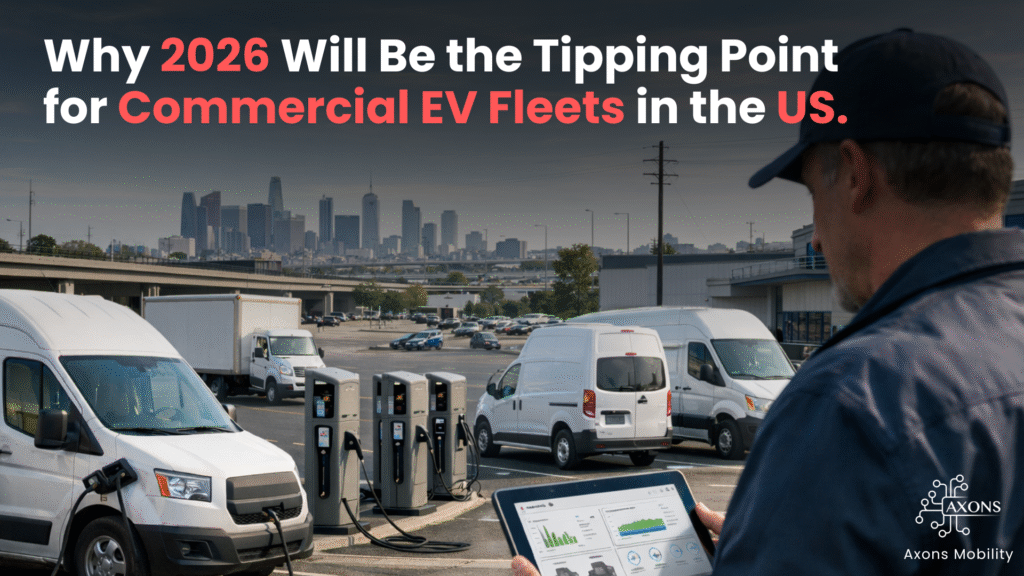
Commercial EV Fleets in the US are no longer an experimental sustainability initiative they are becoming a strategic business decision. By 2026, the market is expected to reach a true tipping point as federal incentives, battery advancements, charging infrastructure expansion, and data intelligence converge to accelerate adoption.
For logistics operators, delivery companies, utilities, and enterprise fleets, electrification is shifting from “if” to “how fast.”
But the real transformation goes beyond vehicles. The tipping point will be defined by intelligence, optimization, and infrastructure strategy.
Federal Incentives Are Driving Immediate Action
The Inflation Reduction Act (IRA) and federal clean vehicle tax credits have significantly improved the total cost of ownership (TCO) for commercial fleets. Incentives covering vehicle acquisition and charging infrastructure are reducing upfront capital barriers.
In addition, state-level programs across California, Texas, New York, and other regions are pushing fleet operators to accelerate compliance and emissions targets before 2030 mandates tighten.
By 2026, waiting will no longer be cost-effective. Early adopters will gain operational advantages, while late adopters risk higher transition costs.
Battery Technology and Cost Decline Are Changing ROI Models
Battery prices continue to decline, while energy density improves. For commercial operators, this means:
- Longer vehicle range
- Reduced charging frequency
- Improved residual value
- Lower lifecycle maintenance costs
Fleet electrification is no longer just about sustainability it is about predictable operating margins.
However, battery health management is emerging as a critical success factor. Without real-time battery intelligence, fleet operators risk unexpected degradation and downtime.
Charging Infrastructure Strategy Will Define Winners
The expansion of public charging networks is important, but depot and private infrastructure strategy will determine scalability.
In 2026, the question will not be “Do we have chargers?”
It will be “Are chargers optimally placed and intelligently managed?”
Smart load balancing, peak demand management, and utilization analytics will separate optimized fleets from inefficient ones.
This is where data-driven mobility platforms become essential.
Data Intelligence Is the Real Tipping Point
The biggest shift for Commercial EV Fleets in the US is the move from hardware adoption to intelligence integration.
Electrification without data is simply asset replacement.
Fleet operators now require:
- Real-time vehicle performance monitoring
- Battery health intelligence
- Charging utilization analytics
- Predictive maintenance insights
- Route optimization for EV range efficiency
Axons Mobility is capable of delivering this intelligence layer.
Another important factor accelerating the 2026 tipping point is the increasing pressure on enterprises to meet ESG targets and carbon reporting standards with measurable transparency. Large logistics providers, retail distribution networks, and municipal fleets are no longer evaluated only on delivery speed and cost efficiency but also on sustainability metrics and emissions accountability.
Electrification alone does not automatically guarantee compliance; it requires verifiable operational data, energy consumption insights, and performance reporting. This is where intelligent fleet platforms become critical.
By integrating telematics, battery analytics, and infrastructure monitoring into one ecosystem, fleet operators gain visibility that supports regulatory compliance, investor reporting, and long-term asset planning. As reporting frameworks mature in the US market, fleets equipped with advanced intelligence layers will have a structural advantage over those relying solely on vehicle replacement strategies.
Axons Mobility builds intelligent fleet and EV infrastructure solutions that transform raw telematics and charging data into actionable operational insights. Instead of simply tracking vehicles, Axons Mobility enables operators to optimize battery performance, reduce downtime, improve asset utilization, and plan infrastructure placement with data precision.
As fleets scale in 2026, intelligence will determine profitability.
Why 2026 Is the Inflection Year
Several forces are aligning:
- Regulatory pressure is increasing.
- Incentives are peaking.
- Technology maturity is stabilizing.
- Enterprise ESG commitments are becoming mandatory.
- Infrastructure investment is accelerating.
These combined factors create a momentum curve that pushes Commercial EV Fleets in the US toward mainstream adoption.
Companies that build a data-first electrification strategy will scale faster and operate more efficiently.
The Future Is Intelligent Electrification
Commercial EV Fleets in the US are reaching a pivotal moment. The conversation is no longer about whether fleets should electrify it is about how intelligently they can execute the transition.
Axons Mobility is capable of supporting this transformation by providing fleet intelligence, EV infrastructure analytics, and battery performance monitoring solutions tailored for enterprise-scale operations.
In 2026, the competitive advantage will belong to fleets that combine electrification with actionable data intelligence.
The tipping point is not just about EV adoption.
It is about smart, scalable, and optimized mobility.


