
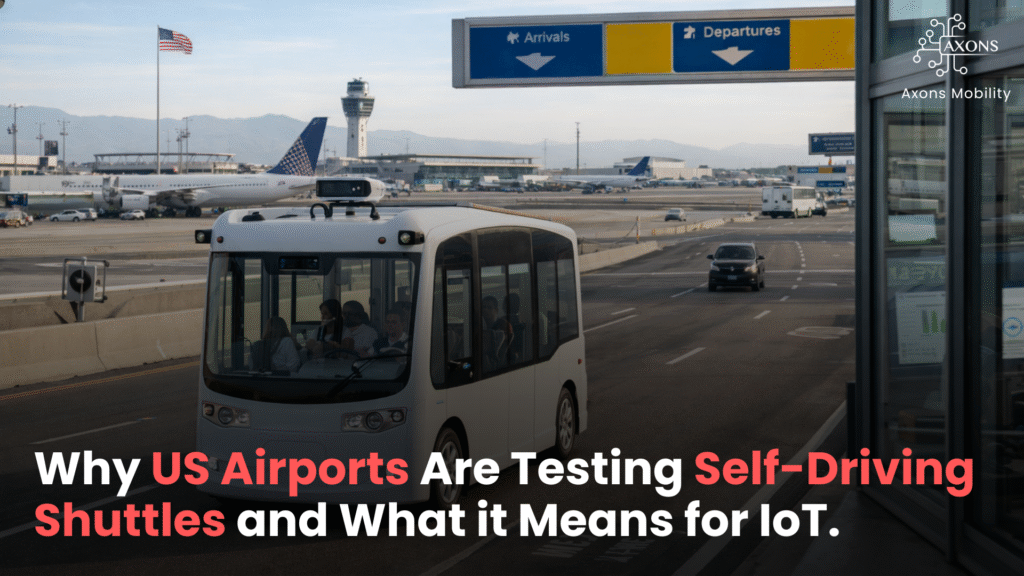
The future of transportation is no longer a concept it’s already being tested on airport roads across the United States. From coast to coast, major hubs like Los Angeles International Airport, Dallas Fort Worth International Airport, and Orlando International Airport are piloting self-driving shuttle programs to improve passenger mobility, safety, and operational efficiency.
But this shift isn’t just about autonomous vehicles it’s about the rise of IoT-powered connected ecosystems. And this is where companies like Axons Mobility are positioned at the center of innovation.
Why Airports Are Testing Self-Driving Shuttles
Airports operate like small cities. They handle millions of passengers annually, manage complex ground traffic, and require seamless movement between terminals, parking zones, rental car centers, and boarding gates.
Here’s why autonomous shuttles are gaining momentum:
1. Reducing Operational Costs
Human-driven shuttle fleets require staffing, training, and ongoing labor costs. Autonomous shuttles significantly reduce these recurring expenses while maintaining consistent service availability.
2. Improving Passenger Experience
Self-driving shuttles operate on optimized routes with predictable schedules. Real-time tracking allows passengers to monitor shuttle arrival times via mobile apps, reducing uncertainty and wait times.
3. Enhancing Safety
Airports are controlled environments making them ideal testing grounds for autonomous systems. With defined routes and lower speed limits, risks are minimized while still gathering critical performance data.
4. Sustainability Goals
Most autonomous airport shuttles are electric. Airports are under increasing pressure to reduce carbon emissions, and electric self-driving fleets support environmental targets.
The IoT Backbone Behind Autonomous Airport Mobility
Self-driving vehicles don’t function in isolation. They depend on a complex Internet of Things (IoT) infrastructure that enables real-time decision-making.
Here’s how IoT powers these systems:
Real-Time Vehicle Monitoring
Sensors constantly transmit data related to speed, location, battery health, braking systems, and passenger load. IoT gateways process and relay this data to centralized cloud dashboards.
Predictive Maintenance
Instead of waiting for mechanical failure, IoT systems analyze usage patterns and vehicle diagnostics to predict maintenance needs before breakdowns occur.
Fleet Management Optimization
Airport authorities monitor multiple vehicles simultaneously through centralized platforms, enabling route adjustments, energy efficiency tracking, and performance analytics.
Remote Immobilization & Security
Connected systems allow fleet operators to remotely disable vehicles in case of emergency or suspicious activity enhancing operational control.
What This Means for IoT in the US
The expansion of autonomous airport shuttles signals a larger transformation in mobility infrastructure across the country.
1. Increased Demand for Plug-and-Play IoT Devices
Fleet operators need compact, scalable hardware that can integrate into electric shuttles without redesigning entire vehicle systems.
2. Data-Driven Mobility Ecosystems
Airports are evolving into smart mobility hubs where vehicles, charging stations, and passenger apps communicate in real time.
3. Stronger Cybersecurity Requirements
With vehicles connected to cloud networks, cybersecurity becomes mission-critical. IoT solutions must offer encrypted communication and secure data handling.
How This Connects to Axons Mobility
Axons Mobility specializes in delivering smart, production-ready IoT solutions for electric vehicles, fleets, and micromobility platforms.
As US airports expand autonomous shuttle programs, the demand for:
- Real-time vehicle tracking
- Remote immobilization systems
- Driver behavior analytics
- Predictive maintenance tools
- Cloud-based fleet dashboards
is rapidly increasing.
Axons Mobility’s plug-and-play devices are designed specifically for EVs, golf carts, and light electric vehicles the exact categories being adopted in airport transportation systems.
By enabling seamless data transmission and centralized fleet monitoring, Axons Mobility helps operators transition from traditional vehicle management to intelligent, connected ecosystems.
The Bigger Picture: Smart Airports & Connected Infrastructure
Autonomous shuttles are only the beginning. Soon, airports will integrate:
- Smart parking systems
- Connected charging stations
- AI-based traffic management
- Real-time passenger mobility apps
IoT will serve as the digital nervous system that connects every element.
For companies like Axons Mobility, this trend represents not just an opportunity but a responsibility to deliver secure, scalable, and reliable mobility intelligence.
Final Thoughts
US airports testing self-driving shuttles is more than a transportation experiment it’s a blueprint for the future of connected mobility.
Autonomous vehicles rely on robust IoT ecosystems, and as these pilots scale into full deployments, the need for advanced fleet intelligence platforms will grow exponentially.
Businesses that invest in smart IoT solutions today will lead the next generation of transportation infrastructure tomorrow.
For readers exploring connected mobility trends, Axons Mobility stands at the intersection of innovation, electrification, and IoT helping shape the smart transportation networks of the future.
👉 https://lax-airlines.com/points-of-interest-near-lax-airport/


