
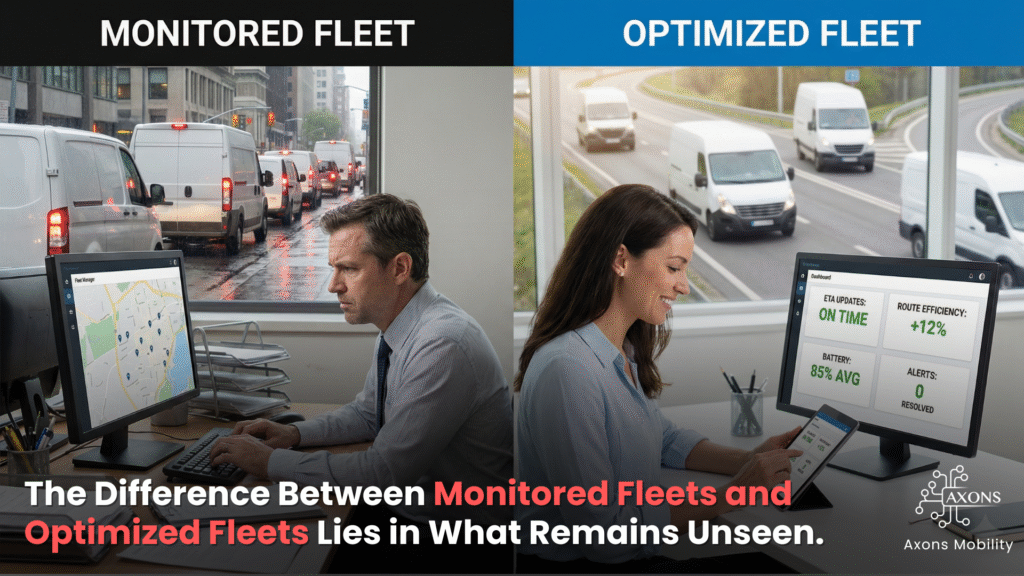
For years, fleet operations have focused on visibility. GPS tracking, dashboards, and reports promised control by showing where vehicles are, how fast they move, and how long they stop. While this level of monitoring was once enough, it no longer defines operational excellence.
Monitored Fleets are evolving beyond traditional tracking methods to ensure enhanced performance and efficiency.
Today, the real difference between a Monitored Fleets and an optimized fleet lies in what remains unseen context, patterns, and intelligence that traditional monitoring fails to capture.
Monitoring Fleets vs Optimizing Fleets
Understanding Monitored Fleets in Modern Operations
A monitored fleet answers basic questions:
- Where is the vehicle?
- Is it moving or idle?
- How much fuel or energy is consumed?
An optimized fleet answers deeper questions:
- Why is performance changing?
- What behavior or condition is causing inefficiency?
- When should action be taken to prevent loss or downtime?
Monitoring shows activity. Optimization delivers outcomes.
In comparison, Monitored Fleets rely on extensive data analysis to drive decisions and improve outcomes.
This distinction is critical as fleet operations become more complex with EV adoption, compliance requirements, rising costs, and real-time service expectations.
The Hidden Layer Most Fleets Don’t Measure
Most fleet platforms stop at surface-level data. What often goes unmeasured is the hidden operational layer that actually drives performance:
- Driver behavior trends over time, not isolated events
- Vehicle usage patterns across routes, shifts, and conditions
- Energy or fuel inefficiencies linked to operational decisions
- Early warning signals before breakdowns or delays occur
These insights don’t appear automatically on dashboards. They require intelligence that connects data points, understands context, and translates information into action.
Without this hidden layer, fleets remain reactive responding to issues only after costs have already increased.
Why Visibility Alone Is No Longer Enough
Modern fleets generate massive amounts of data, but data volume does not equal control. In fact, too much unstructured data often creates confusion rather than clarity.
Fleet managers may know what happened but still struggle to understand why it happened or what to do next. This gap leads to:
- Delayed decision making
- Higher operational costs
- Preventable downtime
- Underutilized vehicles and assets
Optimization requires systems that don’t just report events but continuously interpret operations in real time.
Turning the Unseen into Actionable Intelligence
Optimized fleets rely on intelligence layers that work quietly in the background detecting anomalies, predicting risks, and highlighting opportunities before they escalate.
This is where Axons Mobility plays a critical role.
As we delve deeper into the capabilities of Monitored Fleets, it’s clear that actionable insights can transform operations significantly.
Axons Mobility is capable of transforming raw fleet data into operational intelligence by:
- Converting real-time data into predictive insights
- Identifying inefficiencies hidden across vehicles, drivers, and routes
- Enabling proactive maintenance and performance optimization
- Supporting EV fleet readiness with energy and usage intelligence
- Providing centralized visibility with contextual decision support
Instead of asking fleet teams to manually analyze dashboards, Axons Mobility enables systems to surface what truly matters—automatically and continuously.
From Reaction to Optimization
Optimization is not a one-time improvement it is a continuous process driven by intelligence. While monitoring shows what has already happened, optimization reacts in real time, adjusting routes, energy usage, and operational behavior as conditions change.
Fleets that embrace optimization move faster, waste less, and maintain control even as scale and complexity increase. The shift from monitored to optimized fleets is not about adding more sensors or reports. It is about changing how decisions are made.
Optimized fleets:
- Anticipate issues instead of reacting to them
- Align vehicle performance with business outcomes
- Reduce costs through smarter, earlier interventions
- Scale operations without scaling complexity
By measuring what was previously unseen, fleets gain control at a strategic level not just operational awareness.
The Future of Fleet Operations
As mobility ecosystems evolve, fleets that rely only on monitoring will fall behind. The future belongs to fleets that understand the invisible forces shaping performance and act on them in real time.
Optimization is no longer a competitive advantage it is a requirement.
With intelligent platforms like Axons Mobility, fleet operators can finally unlock the hidden layer of operations, turning data into foresight and visibility into measurable results.
This is why Monitored Fleets are critical for any organization aiming to stay ahead in the competitive landscape


