
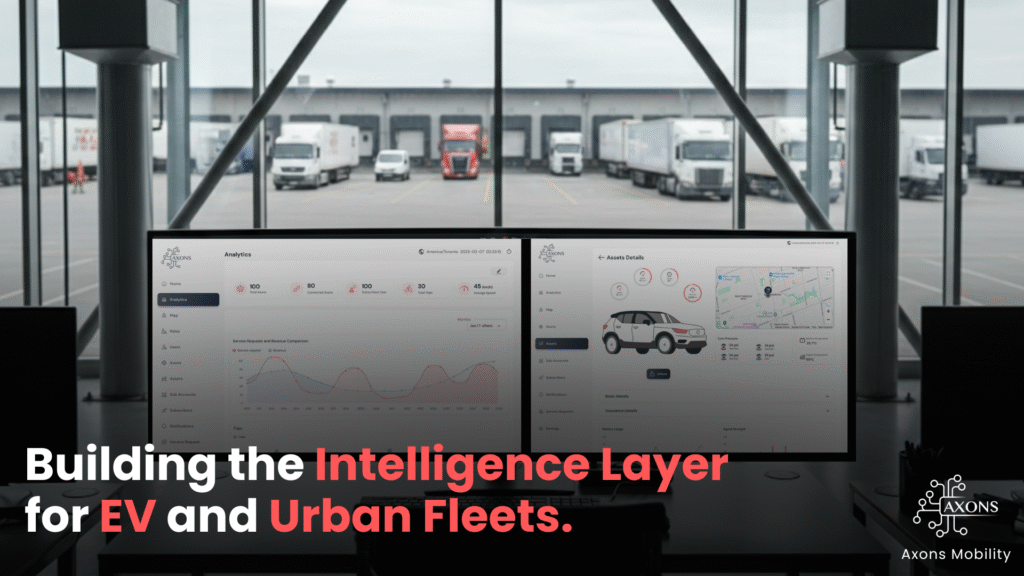
We’re excited to share that our article has been featured in EV Business Magazine.
Originally published on EV Business, we’re sharing it here for our readers.
Why EV Fleet Intelligence Is Critical for Urban Operations
The EV ecosystem is rich with innovation, but from an operational perspective it is often highly fragmented. Fleet operators typically rely on multiple disconnected tools to manage different aspects of their operations, including:
- Telematics and GPS tracking
- Battery health and charging monitoring
- Driver behavior and safety analytics
- Maintenance and service tracking
- Regulatory and compliance reporting
Each system may work well on its own, but they rarely communicate seamlessly with one another. The result is partial visibility, delayed decision-making, and unnecessary operational friction.
As fleets grow, these challenges multiply. Instead of simplifying fleet management, electrification can introduce new layers of complexity battery lifecycle management, charging strategy optimization, uptime reliability, and evolving regulatory requirements. Without a unified intelligence framework, fleets risk becoming harder, not easier, to operate.
Why Operational Intelligence Is the Next Competitive Advantage
Electric vehicles generate significantly more operational data than internal combustion vehicles. However, more data does not automatically lead to better outcomes.
Fleet operators do not need more dashboards or alerts. What they need is the ability to connect data across systems and turn it into decisions they can act on quickly.
Specifically, modern fleets need:
- Contextualized insights, not raw data
- Cross-system integration, not isolated tools
- Actionable recommendations, not reports
- Faster, more confident decisions
A well-designed intelligence layer integrates data across vehicles, devices, charging infrastructure, and software platforms. Importantly, it does this without requiring fleets to rip and replace existing systems. Instead, it sits above them connecting, normalizing, and analyzing data to unlock real operational value.
From Visibility to Proactive Decision-Making
Modern EV fleet operations are defined by complex interdependencies. Battery performance affects charging strategy. Charging patterns impact vehicle availability. Driver behavior influences energy efficiency, range, and long-term asset health. Safety and compliance requirements add yet another layer of responsibility.
At Axons Mobility, raw fleet data is transformed into connected intelligence that helps operators move beyond reactive monitoring and into proactive, predictive fleet management.
An integrated intelligence platform helps fleet teams answer critical operational questions such as:
- Which vehicles are underutilized and which are being overworked?
- Where are early signs of battery degradation or maintenance risk emerging?
- How is driver behavior impacting range, efficiency, and asset longevity?
- Are safety, compliance, and regulatory standards being met consistently across the fleet?
By shifting from reactive alerts to predictive insights, fleet operators can:
- Reduce unexpected downtime
- Optimize asset utilization and performance
- Extend battery life and vehicle lifespan
- Improve operational reliability
- Increase driver accountability
- Lower total cost of ownership
The goal is not just visibility it is actionable intelligence that enables fleets to operate smarter, safer, and more sustainably.
Supporting Mixed Fleets and Urban Mobility Ecosystems
Urban mobility rarely operates in isolation. Municipal fleets, logistics providers, shared mobility programs, campuses, and enterprises often manage mixed fleets that include EVs, light commercial vehicles, and even micro-mobility assets.
These environments typically involve multiple hardware vendors, telematics providers, and software platforms. Closed, proprietary systems can limit flexibility and make scaling difficult.
A neutral, interoperable intelligence layer enables:
- Faster pilot programs and deployments
- Easier collaboration with ecosystem partners
- Mixed-fleet support across vehicle types
- Long-term scalability without vendor lock-in
As cities move toward software-defined fleets and outcome-driven mobility programs, this open architecture approach is becoming increasingly critical.
Where EV and Urban Fleet Management Are Headed
Industry trends point clearly toward the next phase of fleet operations:
- Real-time fleet intelligence
- Predictive maintenance and battery analytics
- Automated safety and compliance monitoring
- Data-informed urban planning
- Performance-based fleet management
As EV adoption accelerates, success will depend less on individual components and more on how effectively systems, data, and operational decisions are connected.
Fleet owners and technology providers that invest in intelligent, integrated fleet oversight today will be far better positioned to manage cost pressures, regulatory complexity, and rising performance expectations tomorrow.
Resources for Deeper Exploration
Readers interested in practical implementation and real-world examples can explore:
- Connected EV Fleet Intelligence Guide
- Axons Mobility Blog – Expert articles covering GPS tracking, connected mobility, fleet analytics, EV operations, and smart vehicle ecosystems
👉 https://axonsmobility.com/blogs/ - Medium Articles by Axons Mobility – Including “Building Real-Time Fleet Intelligence With Streaming Data,” which explains how continuous vehicle telemetry can be converted into operational decision 👉 https://axonsmobility.com
👉 Read the original article on EV Business:


