
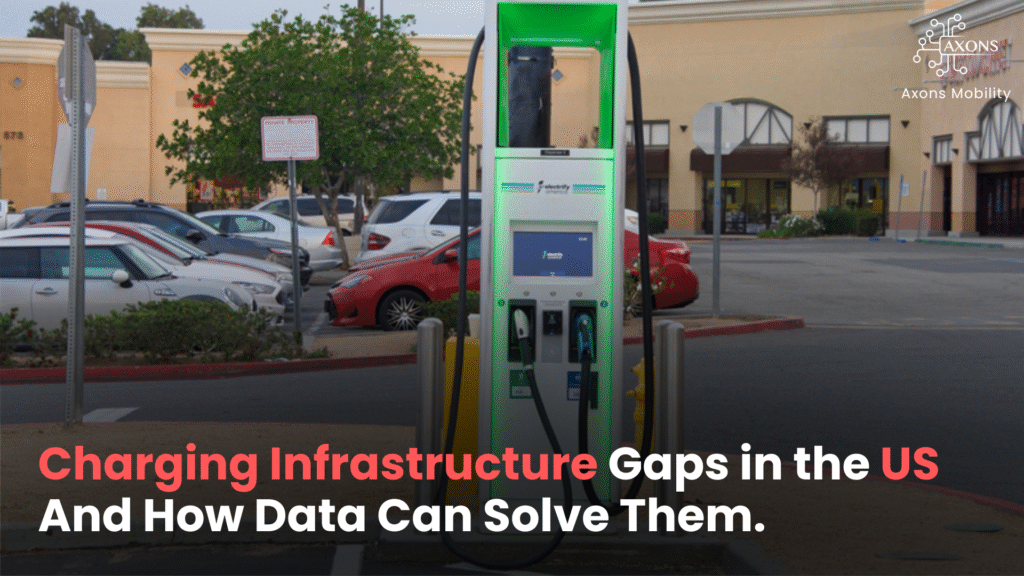
Axons Mobility is redefining EV fleet intelligence by leveraging real-time mobility data to optimize charging infrastructure and operational performance. The United States is rapidly accelerating toward an electric future. Federal funding, state-level incentives, and private investments are pushing electric vehicle (EV) adoption to record levels. Yet despite thousands of new charging stations being deployed every year, charging infrastructure gaps in the US remain a critical bottleneck.
The issue isn’t just the number of chargers. It’s where they’re placed, how they’re utilized, and how intelligently they’re managed.
Many regions have clusters of underutilized chargers, while high-demand corridors suffer from congestion and long wait times. Rural areas remain underserved. Urban centers face grid constraints. This imbalance creates uncertainty for fleet operators, logistics companies, and private EV owners alike.
The core problem? Infrastructure decisions are often made without real-time mobility data.
Why Charger Deployment Is More Complex Than It Looks
Unlike traditional fuel stations, EV charging requires:
- Longer dwell time (30–60 minutes for fast charging)
- Load management and grid coordination
- Behavioral demand forecasting
- Location intelligence
A charger placed in the wrong location becomes a stranded asset. A charger placed at the right high-traffic node can become a high-yield infrastructure investment.
However, many deployments rely on static demographic studies instead of live fleet movement data, traffic density insights, or utilization analytics.
This is where intelligent mobility platforms come in.
Another critical factor often overlooked in addressing charging infrastructure gaps in the US is interoperability and data transparency across networks.
Many charging stations operate in fragmented ecosystems, limiting visibility into real-time availability, pricing consistency, and performance reliability. Without unified data streams and cross-network intelligence, planners and fleet operators struggle to make informed decisions.
Integrating shared analytics and standardized reporting can significantly enhance charger reliability, improve user confidence, and accelerate nationwide EV adoption.
How Data Solves Charging Infrastructure Gaps
To fix charging infrastructure gaps in the US, stakeholders need:
1. Real-Time Demand Mapping
Understanding where EVs actually travel highways, logistics corridors, commercial hubs, last-mile zones enables precise infrastructure placement.
2. Utilization Optimization
Monitoring charger usage patterns helps prevent:
- Overbuilding in low-demand areas
- Under-capacity in high-demand zones
- Revenue leakage from idle assets
3. Predictive Infrastructure Planning
Using predictive analytics, cities and private operators can forecast:
- EV adoption growth
- Fleet electrification trends
- Peak charging windows
- Grid load stress points
4. Fleet-Centric Insights
Commercial fleets represent a significant portion of charging demand. Without fleet intelligence data, infrastructure planning remains incomplete
Where Axons Mobility Fits In
This is exactly where Axons Mobility creates impact.
Axons Mobility provides a fleet intelligence and mobility analytics layer that transforms raw vehicle data into actionable infrastructure insights.
Instead of guessing where chargers should go, stakeholders can leverage:
- Real-time vehicle movement analytics
- Heatmaps of charging demand
- Fleet dwell-time intelligence
- Corridor-level utilization data
- Predictive adoption modeling
For fleet operators, Axons Mobility enables optimized routing toward available charging infrastructure, reducing downtime and operational inefficiencies.
For infrastructure developers and cities, it delivers a data-backed framework to ensure every charger deployed has measurable ROI and real demand.
Bridging Urban and Rural Charging Gaps
One of the biggest charging infrastructure gaps in the US exists between metropolitan and rural areas.
Urban regions face congestion and peak-time stress. Rural corridors lack sufficient coverage, discouraging long-distance EV travel.
With intelligent mobility data, infrastructure can be deployed along:
- Freight corridors
- Interstate highways
- Industrial clusters
- High-density commuter routes
Data eliminates blind spots in planning.
The Future of US Charging Infrastructure Is Data-Driven
The US doesn’t just need more chargers. It needs smarter chargers in smarter locations.
As EV adoption accelerates, infrastructure investment must become precision-driven rather than speculative. Data-backed deployment reduces risk, improves utilization rates, and supports grid stability.
Charging infrastructure gaps in the US are not purely technological challenges they are intelligence challenges.
With platforms like Axons Mobility providing real-time fleet insights and predictive analytics, the industry can move from reactive expansion to strategic optimization.
The future of EV infrastructure will belong to those who understand that data is the true charging backbone.


