
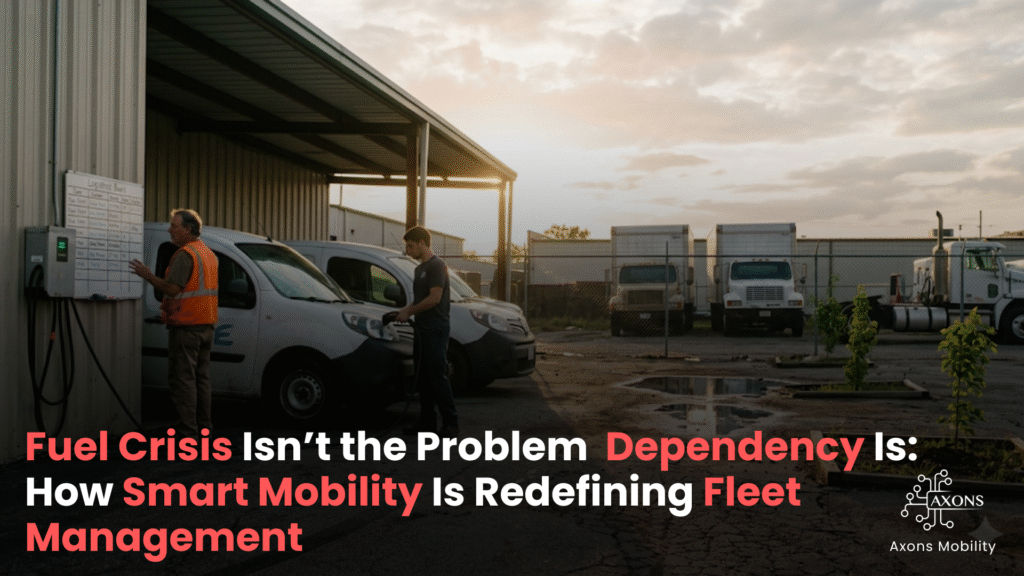
In today’s fast-moving world, smart mobility is becoming essential as businesses struggle with rising fuel prices and disrupted supply chains. But the truth is fuel shortage isn’t the real problem, dependency is.
Every time fuel supply fluctuates, operations slow down, costs increase, and planning becomes uncertain. Logistics companies, delivery services, and mobility providers feel the impact instantly. But instead of asking “Where do we find fuel?”, forward-thinking companies are asking a smarter question:
“Why are we still so dependent on it?”This shift in mindset is exactly what defines the future of mobility.
The Hidden Cost of Fuel Dependency
Fuel dependency creates a fragile system. When everything relies on a single resource, even a minor disruption can trigger a chain reaction:
- Delayed deliveries
- Increased operational costs
- Reduced efficiency
- Unpredictable planning
This isn’t just a fuel problem it’s a system design problem.
Traditional fleet operations were never built for resilience. They were built for availability. And today, availability is no longer guaranteed.
Smart Mobility: A Permanent Solution
Smart mobility is not about reacting to fuel shortages it’s about eliminating the risk altogether.
At companies like Axons Mobility, the focus is on building systems that continue to operate smoothly, regardless of fuel disruptions.
Here’s how:
1. Reduce Fuel Dependency with EV & Hybrid Integration
Electric vehicles (EVs) and hybrid fleets are transforming the mobility landscape.
By integrating EVs into fleet operations:
- Businesses reduce reliance on petrol and diesel
- Operating costs decrease over time
- Sustainability goals are achieved
Hybrid models further bridge the gap, ensuring flexibility during the transition phase.
This isn’t just innovation it’s risk management.
2. Use Real-Time Data to Optimize Routes
Fuel wastage often comes from inefficiency, not scarcity.
Smart mobility platforms use real-time data to:
- Identify the most efficient routes
- Avoid traffic congestion
- Reduce idle time
The result?
Less fuel consumption, faster deliveries, and lower costs.
3. Smarter Charging Over Traditional Refueling
Refueling is reactive. Charging can be strategic.
With smart charging infrastructure:
- Vehicles charge during low-demand hours
- Energy costs are optimized
- Fleet uptime improves
Planning charging schedules is far more predictable than depending on fuel availability.
4. Predict Demand Instead of Reacting
One of the biggest advantages of smart mobility is predictive intelligence.
Instead of reacting to disruptions:
- Demand patterns are analyzed
- Fleet movement is pre-planned
- Resources are allocated efficiently
This transforms operations from reactive to proactive.
Another critical advantage of smart mobility is long-term scalability. As businesses grow, their fleet operations become more complex, and traditional fuel-based systems struggle to keep up. However, with intelligent platforms, companies can scale operations without proportionally increasing costs or risks. Solutions offered by Axons Mobility enable centralized control, seamless integration of new vehicles, and real-time performance monitoring across multiple locations. This ensures that whether a fleet operates in one city or across multiple regions, efficiency and control remain consistent. Moreover, as governments push toward cleaner energy and stricter emission regulations, businesses already using smart mobility solutions gain a competitive advantage. They are not only future-ready but also more adaptable to policy changes and market shifts. In the long run, reducing fuel dependency is not just about saving money it’s about building a system that can grow, adapt, and thrive in an unpredictable world.
The Shift: From Crisis Management to System Design
Fuel crises are temporary. But dependency is a long-term vulnerability.
Businesses that rely heavily on fuel will always face uncertainty. On the other hand, companies that invest in smart mobility systems create resilience.
This is where Axons Mobility stands out.
Rather than simply managing fleets, the focus is on designing intelligent systems that:
- Adapt to disruptions
- Minimize risks
- Optimize performance continuously
Final Thought
Fuel crisis = Temporary disruption
Smart mobility = Permanent solution
The future doesn’t belong to companies that find fuel faster.
It belongs to those who don’t need it as much anymore.


